At Yadkin Valley Mutual Aid, our mission is to empower and uplift our community through collective and inclusive practices. Based in Yadkin Valley, North Carolina, we strive to build a more equitable and resilient community by fostering local food sovereignty, expanding communal access to land, and promoting direct democracy. Embracing principles of mutual aid and collective action, we are dedicated to creating a network of community gardens and local councils that not only nourish our community but also strengthen our shared commitment to social justice and sustainable living.
Points of Unity
The following principles are the Points of Unity which individuals must agree to in order to be admitted as a member of Yadkin Valley Mutual Aid. These Points of Unity represent the principles of the organization, which shape the actions and direction of the organization’s decisions.
1) Direct Democracy
Everyone should have an equal say in making decisions that affect them. We do not elect others to make decisions for us. We make decisions ourselves, as a collective through consensus, and then decide who among us will implement them.
2) Anti-Hierarchy
We oppose all hierarchical power structures. Any system where a small group of people are given the power to dominate others is unjust and must be dismantled. Concentration of decision-making always leads to destruction.
3) Social Ecology
The domination of humanity over nature comes from the domination of human beings over one another. This means that the fate of humanity is intertwined with all other life on Earth. We embrace the holistic and reconstructive dimensions of indigenous knowledge and ecological science.
4) Prefiguration
We seek to solve the current issues in society through the creation of horizontal alternatives. If we want a better society, we must create it in the here and now. This means making social structures that are controlled directly by the community. Everyone deserves unconditional access to food, clean water, housing, healthcare, love, art, and community without requirements (means testing) or the expectation of payback.
5) Common Interest
We all have a unified interest in protecting “a world where many worlds fit” as the Zapatistas say. This is what allows the largest variety of people to be able to live their lives with dignity and autonomy. Our differences do not divide us; they both strengthen and unite us.
6) Responsibility
Members accept that they are responsible for themselves, for their community, and for the world around them. This means not only taking initiative to solve problems and make proactive improvements, but also making sure these solutions are carried through. This also means taking accountability for our failures, correcting harm that has been done, and ensuring further harm is not perpetuated.
7) Solidarity, Not Charity
Charity seeks to reach down to help others who have fallen through the cracks created by the system. We know that it is the system, not the people suffering under it, that creates vulnerability and crisis. We act in solidarity with people to create alternative systems that do not allow communities to suffer. We provide aid without means testing and we help ourselves by helping each other.
8) Direct Action
We seek to use our own political, economic, physical, and creative power to make change. We do not solely vote or lobby established authorities of the system for change, but intervene directly ourselves. This includes mutual aid, alternative economies, and parallel structures to traditional systems. Hope is not in the system; we are the heroes we have been waiting for.
9) Free Association
We hold open meetings with multiple pathways for new people to join and participate in Yadkin Valley Mutual Aid. Members are free to choose whether or not to participate with particular actions of the group.
10) Transparency
We are fully transparent in the operation of Yadkin Valley Mutual Aid. All members are welcome to any information they want regarding any money that is used or managed by the group. Many projects are not funded and all actions are volunteer run. There is no expectation of payment or repayment for any projects of actions performed by the group.
Membership
Summary
Members of Yadkin Valley Mutual Aid will be those who in free and mutual association have joined and been recognized as members. Membership will not be barred on the basis of background or identity. (An explanation of the roles played by Green, Yellow and Red CIrcles can be found below).
Yadkin Valley Mutual Aid uses the concept of concentric circles. These concentric circles are divided into three levels of involvement, commitment, and responsibility, each nested within the last. These circles do not represent any form of authority or control over another. There is no limit to the number of people in each circle and membership in the circles can be fluid.
Anyone who agrees to the Points of Unity of Yadkin Valley Mutual Aid can become a part of the Green Circle, but entry must be approved by all Green, Yellow and Red Circle individuals. Individuals within the Green Circle are not yet considered part of Yadkin Valley Mutual Aid’s membership and are not counted for quorum/consensus during Member’s Council Meetings, but are still allowed to attend and contribute. After a period of 3 months, individuals in the Green Circle are able to join the Yellow Circle. Individuals within the Yellow Circle are considered part of Yadkin Valley Mutual Aid’s membership and are counted for quorum/consensus during Council Meetings. Individuals within the Yellow Circle must be paired with a Red or Yellow member for mentorship for further political development and understanding of organizational tasks for the first month in the Yellow Circle. Individuals who have the capacity to focus on long-term goals and can spend at least a few hours weekly on administrative tasks can join the Red Circle.
These roles are not static. Individuals may move to the Yellow Circle or the Green Circle from the Red, for instance, if an individual’s availability changes or they wish to focus their energies elsewhere. In the Green Circle, individuals are not prohibited from discussing or giving their input on strategy or helping out with administrative work, but it is not expected of them. Each circle sets how much an individual would like to commit and self-manage, while also developing trust over time via their commitments.
Descriptions & Expectations
Green Circle (Affiliates)
Not yet considered part of Yadkin Valley Mutual Aid’s membership.
Must make a verbal agreement to Points of Unity.
No commitments, but expected to learn and volunteer.
Not counted for quorum/consensus during Member’s Council Meetings, but are still welcome to attend.
Not expected to be politically developed and are encouraged to attend education programs.
Entry approved by consensus of all circles.
Yellow Circle (Members – Neighbors)
3 months in the Green Circle or shows high levels of commitment and participation in the organization.
Considered part of Yadkin Valley Mutual Aid’s membership.
Will be paired with a Red or long-standing Yellow member for mentorship to further theoretical development and understanding organizational tasks for the first month in the Yellow Circle.
In rotation for inreach/outreach tasks.
Access to organizational information.
Counted for quorum/consensus during Member’s Council Meetings.
Encouraged to participate in as many learning and outreach opportunities as possible.
Not expected to have the same level of time commitment as Red, but must maintain monthly participation.
Entry approved by consensus of Red and Yellow Circles.
Red Circle (Members – Comrades)
6 months in the Yellow Circle or shows high levels of commitment and participation in organizational tasks.
Commitment to internal work.
On rotation for administrative and organizational tasks.
Access to sensitive organizational information.
Expected to be present for all general Member’s Council Meetings.
Entry approved by consensus of the Yellow and Red circle.
Meeting Types
Community Assembly
The Community Assembly is the public-facing body of Yadkin Valley Mutual Aid, and is open for both members and non-members to participate. The Community Assembly gives public feedback to Yadkin Valley Mutual Aid, and provides a regular place for community collaboration and development. The Community Assembly should be held monthly if possible but at least once every three months.
Member’s Council
The Member’s Council is the administrative body of Yadkin Valley Mutual Aid. Attendance is open to all, but only members may participate fully in decisions of the Member’s Council. As opposed to the Community Assembly, Member’s Council Meetings revolve around administrative duties, internal matters, external messaging, and implementation of the policies and proposals. The Member’s Council focuses on dealing with member conflicts, developing immediate strategy, coordinating between working groups, identifying organizational issues, working through immediate issues, coordinating between roles, and providing as-needed support to role functions. Member Council Meetings should be held biweekly if possible but at least once per month.
Affinity Groups
An Affinity Group is the strategic implementation and organizing body of Yadkin Valley Mutual Aid. Attendance is open to members and non-members of Yadkin Valley Mutual Aid. An Affinity Group is a flexible coalition that forms around a particular passion or general concept. Examples include Community Garden, Web Development, Educational Outreach, planning for a particular Action, Organizing Aid for a specific individual etc. The possibilities are endless and dependent on particular participants’ desires. Affinity Groups are often temporary by nature. Reports, requests and updates are brought to Member’s Council Meetings.
Meeting Roles
(from “How to Organise a Meeting,” John R)
Members of Yadkin Valley Mutual Aid are delegated to serve roles during a meeting, lasting only until the end of that meeting; roles are recallable at any time if deemed necessary by members. Different roles may be needed depending on the size of each meeting (Facilitator, Minute Taker, Queue Keeper, Time/Agenda Keeper, Vibe-Watcher, and Attendee).
Facilitator:
The facilitator’s role is to help the group have a well run and inclusive meeting, encouraging similar levels of input from everyone, keeping the meeting focussed on one item at a time until a decision is reached by the group. The facilitator does not direct the group or make decisions for them, and the role should be rotated through all group members, it is a skill that almost anyone can learn. Facilitators make sure that the rules of Yadkin Valley Mutual Aid’s decision making process are being followed and keep the meeting on track in order to proceed through the agenda. Facilitators should not intercede their opinions or direct discussion in any particular direction, and should be a neutral party that seeks to maintain good will and ease tensions, while keeping order of the meetings. Facilitators may keep track and make a list of everyone who needs to speak during meetings (but see Queue Keeper below). If stacking is used (see Decision Making), Facilitators must make sure that the stack goes in order of the first individual to raise a request to go on stack. Facilitators must enforce the progressive stack.
Facilitator’s Role:
Prepares the agenda before the meeting
Makes sure the meeting location is appropriate for all attendees: accessibility, temperature, etc
Sends around any pre-meeting materials
Explains at the beginning what the meeting is about and how it will run
Does a go-around to have everyone introduce themselves to the group (called a check-in)
Has access to the minutes of the last meeting
Looks for agenda items from attendees at the beginning of the meeting
Organizes agenda items into an appropriate order
Can add a time limit/guideline for each agenda point
Keeps the meeting running smoothly and on-agenda and tries to keep agenda items to their stated time limits
Makes sure one person at a time speaks
Calls on the person whose turn it is to speak
Discourages people talking out of turn
Encourages people to speak who haven’t spoken or have been speaking less than others (or asks more vocal attendees to hold back)
Keeps the numbers of direct responses down, 3 per person per discussion is a good rough limit
Writes down all proposals on a whiteboard
Engages the meeting on said proposals and tries to get to consensus
Makes sure people feel ready to make a decision on a proposal
At the end of the meeting checks to see if the group would like any of the agenda items or decisions revisited at the next meeting
Has a closing go-around (a check-out) to check how the group feels the meeting went, if aims were reached, actions apportioned fairly, and everything discussed thoroughly
Publish next meeting date
Minute Taker’s Role:
Writes down the date of the meeting
Takes down the names of attendees
Records action items, proposals, decisions, agenda items for the next meeting, and any other important points such as volunteers or interesting bits of conversation
Minuting everything that’s said is very difficult and is probably unnecessary, if this is required, consider recording the meeting, otherwise just write down the topics discussed
After the meeting, distributes the minutes to group members
Either keeps a record of the meetings somewhere secure or discards them
Redacts anything that participants do not want recorded for security reasons
Queue Keeper’s Role: (if needed for larger meeting)
Manages the Stack including the Progressive Stack
Crosses out the names of those who have spoken
If queue keeper wishes to speak, adds their name to bottom of the queue
If someone has a direct response or a technical point and the facilitator hasn’t noticed, alerts them
Writes down any proposals that are announced (can also be performed by the time keeper, see below)
Time/Agenda Keeper’s Role: (if needed for larger meeting)
Keeps track of the time spent on each agenda item and alerts the group, or facilitator, when the time limit allotted to an item is approaching
Negotiates extra time for agenda items or the whole meeting, if necessary
Writes agenda items up as they are announced
Crosses out agenda items once discussion has finished
Writes down any proposals that are announced
In longer meetings, calls for a break after one hour
Vibe Watcher’s Role: (if needed for larger meeting)
Pays attention to the group dynamics and emotional atmosphere, listening carefully and observing body language.
Intervenes, if it seems necessary, in situations of distress or conflict, perhaps suggesting one-on-one time-outs or smaller discussions
Suggests breaks or energising activities where they seem appropriate or required, meetings should be fun and enjoyable where possible
Attendee’s Role:
Sends around any pre-meeting material
Puts hand up to speak (see below)
If someone has their hand up but the queue keeper or facilitator hasn’t noticed, points at the person
Similarly, if a proposal is made and neither the facilitator nor the queue keeper have noted it, indicates a technical point (see below)
Self-facilitates as much as possible: if you have been speaking often or for a long time try to let others in ahead of you, if you are called upon to speak but you don’t think it’s your turn point it out
Uses the hand signals in larger groups:
hand up = add me to the queue please
wavy hands pointing upwards = approval
wavy hands pointing downwards = disapproval
wavy hands pointing out from the body = ambivalence or not sure
T-sign = technical point — not related to the discussion but to something ancillary
two hands up (or a finger on each hand) = I wish to jump the queue to give a brief direct response to something just said
Alternative: Stacking
Input from the Green Circle will be considered during the consensus process, but will not count towards quorum or consensus.
Decision Making
Summary
Consensus is a decision-making process in which participants of an organization or group develop and decide on proposals with the requirement of reaching an agreement between all members of a group. Instead of voting for an item and having the majority of the group getting their way (and a minority losing), consensus decision-making is committed to finding solutions that everyone can support. Consensus decision-making ensures that all opinions, ideas and concerns are taken into account. No decision is made against the will of an individual or a minority. If significant concerns remain unresolved, a proposal can be blocked and prevented from going ahead.
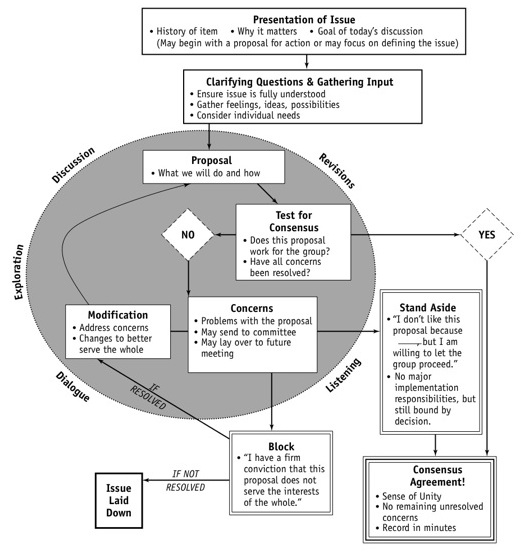
Consensus decision making in Yadkin Valley Mutual Aid follows this general format: an issue is presented to the group, clarifying discussion ensues, ideas are shared, a proposal is made, concerns and modifications are heard, the group comes together and tests for agreement, meets and answers objections and, if none remain, approves the decision and names out the next steps for action. If objections still remain, the issue is blocked or postponed until the next meeting.
The model presented above functions as the consensus process for Yadkin Valley Mutual Aid’s Community Assemblies, Member’s Council Meetings, and Affinity Group meetings. The input and concerns of all members of Yadkin Valley Mutual Aid should be discussed throughout the consensus process. Decisions cannot be passed until all members can agree. Decisions can be re-addressed or revised at a later time if members have concerns or new proposals.
Process
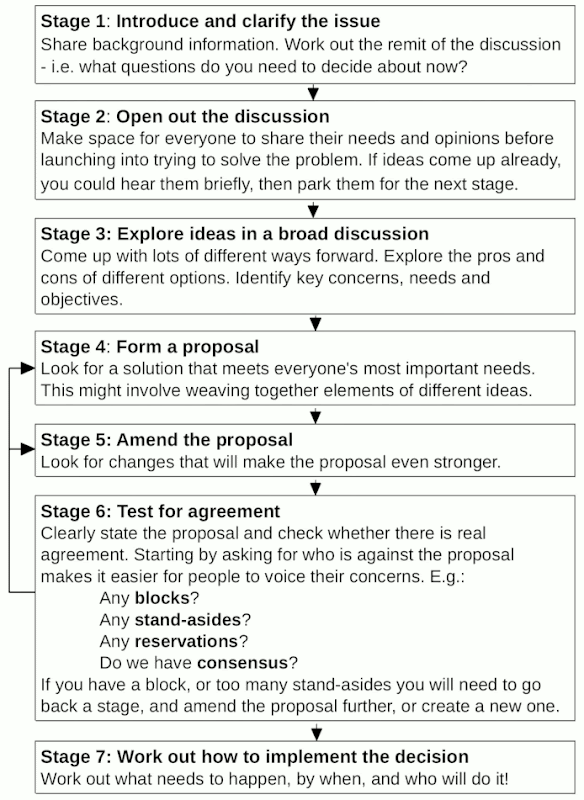
The consensus process starts by introducing and clarifying an issue. This ensures that everyone has the relevant background information and the group is clear about the purpose of the discussion and key questions to resolve. This stage in the consensus process is opening up the discussion to allow everyone to share their feelings, needs, and opinions, before trying to find a solution. Individuals should resist the temptation to make proposals at this stage. If ideas come up, they can be presented briefly and brought up later for the next stage. Once a good understanding of what is important to people has been gauged, participants can collect and explore ideas moving forward. Looking at the pros and cons of different ideas helps the group with understanding everyone’s key needs and concerns. The group then looks for common ground and covers options in order to form a verbal or written proposal. Clarifying and amending the proposal helps to address any remaining concerns. Participants then test for agreement by clearly stating the final proposal and asking people to signal whether they agree or disagree. This stage is important to check if there are concerns that haven’t been heard. If a proposal does not have consensus, participants must go back to the appropriate stage of the consensus process or the proposal can be presented during the next meeting. If consensus has been reached, participants then figure out how to implement the proposal.
Consensus Flowchart
Discussion:
This is a period where the floor is opened to discussion. It should be limited to some set amount of time for each meeting, so that it does not overflow and disallow time for proposals and consensus testing. During this period, the facilitator may ask for a non-binding “temperature check” of everyone that is present in order to gauge support for an item under discussion.
This is a period where consensus for a proposal is tested. A resolution is presented by an individual. Following this, there is a discussion period about the resolution. After this discussion has concluded, the members perform a temperature check and the results are tallied. If the first tally is unanimous, the measure is passed and planning will begin. If not, members who have concerns are asked to further explain their opinions and concerns. After members have presented their opinions and concerns, members are asked to weigh in on their agreement with the concerns and those who presented the concerns offer amendments that, if instituted, would garner their support. These amendments are then considered and the status of consensus is re-assessed.
Meeting Groups (Community Assembly, Member’s Council and Affinity Groups) must have two thirds of the group present in order to have a quorum. Quorum must be present in order for consensus to be reached. Every effort should be made to include all members who want to be present for each meeting (via invitation, Zoom, speakerphone etc). Yadkin Valley Mutual Aid must have two-thirds of members from the Yellow and Red circles present and in agreement during the Member’s Council meeting in order to achieve quorum. If there is consensus, and if quorum has been achieved, the proposal will be passed and planning will begin. Otherwise, the proposal is postponed for the next meeting or dismissed.
Principles
Stack:
Only one person speaks at a time. Stacks will be kept during meetings in order to ensure that speakers are able to convey their message without interruption. Stack will go in order of the first individual to raise a request to go on stack or follow progressive stack.
Progressive Stack:
Facilitators should put any person that is a part of any socially/historically marginalized community/background, or even those who have not spoken yet, at the top of the stack. This ensures that those with marginalized voices are always heard and are not tread underneath those with majority perspectives or backgrounds.
Hand Signals:
Hand signals are used during the discussion period to streamline and facilitate communication with larger groups:
hand up = add me to the queue please
wavy hands pointing upwards = approval
wavy hands pointing downwards = disapproval
wavy hands pointing out from the body = ambivalence or not sure
T-sign = technical point — not related to the discussion but to something ancillary
two hands up (or a finger on each hand) = I wish to jump the queue to give a brief direct response to something just said
Active Participation:
Individuals should listen to what everyone has to say and proactively look for solutions that include everyone, as well as voice their thoughts and feelings.
Mutual Respect:
Even when having heated disputes, individuals should avoid insulting one another or assuming bad faith; instead, assume positive intent. Individuals should be as direct and brief as possible to give time for others on stack to speak. Individuals should refrain from interruption unless it is required by the facilitator. Individuals should be willing to work towards the solution that’s best for everyone, not just what’s best for themselves. Individuals should make an effort to understand another person’s position, underlying needs, concerns and emotions. Remember, one does not win discussions or consensus.
Flexibility:
Individuals should be flexible and willing to give something up to reach an agreement. If another proposal is good, don’t complicate matters by opposing it just because it isn’t your favorite idea.
Clarity:
Individuals should be open and honest about the reasons for their viewpoints rather than presenting the reasons that are most likely to convince other people. Individuals should try to express their concerns early on in the process so that they can be taken into account in proposals.
Constructive Disagreement:
Individuals should engage in giving constructive disagreement during the decision making process. Differences of opinion are natural and to be expected. Disagreements can help a group’s decision, because with a wide range of information and opinions, there is a greater chance the group will find good solutions. Easily reached consensus may cover up the fact that some people don’t feel safe or confident enough to express their disagreements.
Proposal Process
Summary
Everyone involved in Yadkin Valley Mutual Aid can make a proposal, including non-members. Proposals can be made at any Community Assembly, Member’s Council, or Affinity Group meeting, as well as using Yadkin Valley Mutual Aid’s online platforms. Proposals can be verbal or written. People that are involved with reaching consensus on the proposal, as well as delegates (see below), have a responsibility to carry out the proposal.
Community Assemblies involve the public and are for setting wider policy and orientation for the organization. Community Assembly meeting agendas often are prepared ahead of time to talk through and generate ideas for proposals, and then open assembly time to move through them. Individuals can write a proposal in advance to have time set aside for it.
Member’s Councils are focused on organizational and implementation questions. If an individual wants to make changes to those, proposals should be brought up to the council, preferably in written form. Likewise, if an individual has concerns about how one of Yadkin Valley Mutual Aid’s projects is being implemented or managed, this is the best venue in which to do so.
If a proposal does not have specific agenda time allotted for it, the most appropriate time to offer a proposal is during any period marked for “discussion.” Remember that agendas can also be modified by consensus at any time, so if an individual wants to have some time to present a proposal, they can be placed on stack and ask the group if it would be an appropriate time to do so. During a meeting, the facilitator will usually make it clear when proposals are to be heard. Individuals should be clear when they are called upon to speak when offering to make a proposal. Sometimes, when people are presenting ideas for addressing an issue, the facilitator may synthesize these ideas into a verbal proposal.
Process
Verbal Proposals
Verbal proposals should outline the issue to be addressed briefly and concisely. Verbal proposals must outline a mandate to approve in a few sentences. Verbal proposals are best for simple and direct actions; anything more long-term or complicated is best presented as a written proposal.
Written Proposals
Written proposals should be split into four sections: A title and attribution to the authors at the time, a short bullet-point summary of the proposal, a section outlining the necessity of the proposal, and one or more detailed instructions that explain how the proposal should be carried out.
Considerations & Expectations
Individual and organizational capacity should be considered when suggesting a proposal. Time, cost, resources, and participation limitations need to be taken into account before issuing a proposal. It must be made clear if a proposal needs a specific amount of labor to be successful. When a proposal is approved, one or more delegates are also appointed to be “point person” for that proposal. It is expected that for every proposal, the one who drafts it will be one of the delegates assigned to carry the proposal out.
Another expectation is that after a proposal is made, the delegates responsible for it will report back at every future Community Assembly and/or Council Meeting. For Affinity Groups, a written report is requested every other week at Member’s Council Meetings. For larger projects, a written report is requested once a month at the Community Assembly. These reports do not need to be extensive, and can re-iterate previous reports, but will help maintain accessibility and transparency to information for members of the organization. If reports are not forthcoming, it signals to the organization that additional help may be required, or that the proposal needs to take a step back. If delegates are not available to make a report in-person, a short report via email to the organization (INSERT E-MAIL HERE) will suffice.
Delegation
Summary
A delegate is a point person for a particular action or proposal passed by members of Yadkin Valley Mutual Aid. Delegates are selected by consensus. A delegate is recallable through consensus of those involved in the action or proposal. In Yadkin Valley Mutual Aid, there are four standing delegated roles that carry out critical tasks within the organization. Those roles are: Materials Coordinator, Task Monitor, Inreach Coordinator, and Signaling Coordinator (as required based on size).
Roles
Materials Coordinator:
Materials Coordinators are responsible for managing the financial accounts of the organization, including access to its bank accounts and debit card. While any disbursing of funds is subject to the organization’s decision making process, Materials Coordinators carry it out. Materials Coordinators conduct fundraising efforts and provide regular reports to the organization. Materials Coordinators are responsible for storing and managing the communal properties of Yadkin Valley Mutual Aid. Materials Coordinators are delegated every two months.
Task Monitor:
Tasks Monitors are responsible for keeping track of organizational capacity, monitoring burnout, and locating and preventing emergent hierarchies. Tasks Monitors also ensure delegated tasks are carried out, keeping credentials updated. Tasks Monitors give reports on capacity, burnout, and task achievement to the organization. Task Monitors are delegated every two months.
Inreach Coordinator:
Inreach Coordinators are responsible for orienting new members into the organization, conducting inreach efforts with members, updating the Yadkin Valley Mutual Aid organizational calendar, reporting new member engagement, and creating event reminders to the organization. Inreach Coordinators are delegated every two months.
Signaling Coordinator:
Signaling Coordinators are responsible for managing Yadkin Valley Mutual Aid’s social media accounts. Signaling Coordinators post graphics, give updates to social media, answer direct messages on social media, and give reports to the organization. Signaling Coordinators have the responsibility of keeping the passwords of all organizational platforms, and a list of those who have been given access. Signaling Coordinators are delegated every two months.
Spokespersonship
No single person speaks for Yadkin Valley Mutual Aid. Each person represents themselves and their experiences as an individual member of the collective. Statements made as a collective should be drafted and submitted to the Member’s Council for approval. However, delegates may be appointed to represent the group to a coalition, federation, or initiative, but they must act solely as representatives of the wider body and pass along the organization’s positions, while taking back what was said for deliberation. They may speak their minds, but only as an individual.
When it is necessary for longer-term engagement, a spokescouncil of delegates may be formed, appointed within the organization by consensus, to provide a consistent connection between Yadkin Valley Mutual Aid and its immediate partners. A spokescouncil may also be formed by delegates from multiple councils to represent them at an assembly, or as a means to mediate discussion among a large group of people. This model is encouraged for federation and coalition work the organization engages in.
Grievances
Although all of the processes listed above are created precisely to avoid grievances between members of Yadkin Valley Mutual Aid, it is nonetheless the case that legitimate problems will arise between members. We have separated the categories of grievance and included standards for verification, victim protections, and methods for solution.
Conflict/Hurt
This category includes misunderstandings, disagreements, friction between personalities, ongoing annoyance with behavior, etc. These are situations which include reciprocal problems which do not rise to the level of lasting harm or wherein the problems were not intentional, but which are nonetheless causing issues which need to be addressed for the sake of the functioning of the organization or the mental health of participants.
There is also a subcategory of conflict which might simply be described as “hurt,” but not “harm;” where one party has done something which hurt someone’s feelings, but was not necessarily purposeful. People often confuse this category with harm, thinking that their displeasure with the way a person has engaged with them constitutes actual harm, when it really just annoyed them or their personalities simply conflicted.
Verification: Both parties simply need to agree that there is a conflict that needs to be resolved.
Protections: There is generally no need for special protections in these situations.
Solution: The involved parties should agree to a mediator and a discussion should be had where either party is allowed to air their grievances respectfully, seeking remediation. Neither party should enter with preconditions and should agree to engage in good faith. The mediator’s job in this occasion should be to resolve differences amicably, to guide discussion by relating behavior to the guiding principles of the group while respecting the need to encourage healthy range of dispute.
This process should be able to be started or stopped at any time by either party.
Harm
This category is for non-reciprocal damage to a person. One of the parties has caused the problem at hand which has put the other party at risk, caused them serious mental distress, or has placed them in the way of physical harm. This includes interpersonal issues such as inadvertent racism, misogyny, transphobia, xenophobia, classism, and other such issues.
Verification: A mediator should investigate the details of the situation at hand.
Protections: It may be appropriate in this category that the aggrieved request that the person who has done harm takes a hiatus from the group for a period of time. This is decided together with the mediator.
Resolution: The involved parties should try to agree to a mediator, but if the two cannot agree, the party which has been harmed should be allowed to choose the mediator. As has been noted, if the problem at hand is one of identity-based harm (conscious or unconscious), pertinent members with that identity may be called upon to act as mediators in the process. The person who is harmed should be asked to set out what they would like the offending party to do in order to remediate the situation and the offending party should be asked to give an account of their actions. The mediator’s job is not to be neutral, but to focus upon remediation of wrongdoing and thus should seek remediation from the party who has caused harm to the requests of the victim. This represents not only repairing any harm done, but giving assurances that it will not take place again.
This process should be able to be started or stopped at any time by the aggrieved party.
Abuse
This category is for serious violent behavior such as rape, assault, or harassment. This damage is one-sided or nearly one-sided. Harassment includes repetitive, blatant incidents of racism, misogyny, transphobia, xenophobia, classism, and other such issues.
Verification: An extensive fact-finding mission should be done by a chosen mediator, trying to uncover times, locations, and evidence. If the incident involved words, evidence of claimed correspondence in the form of chat logs, eyewitnesses, or other forms of verification should be sought out.
Protections: The abused may request that they and the member not occupy a space for the duration of the grievance process.
Resolution: The resolution for this category begins with the abused party choosing the mediator. The abused party should set the agenda of the conversation and should be given the right to decide how the interaction will continue. They may choose to set conditions for remediation or ask that the abusive member be expelled from the group as a result. The mediator’s job is to provide a space that is safe for the victim to air their grievance as they please to the abuser. The mediator’s job in this occasion is not to provide defense to the abuser, but to open the floor to the victim to propose the course of action if they are to continue associating with the abuser. The aggrieved may ask that the member in question, if they do not live up to the needs of the victim, are removed from the group.
This process should be able to be started or stopped at any time by the aggrieved party.
Charter Violation
This category is for behavior which violates the stated points of unity of the charter in a way which is beyond simple incompetence. This is for the occasion where someone has not carried out any of these previous categories (or at least their actions cannot be cleanly grouped into one of these), but their actions clearly contradict the stipulations of the charter or points of unity.
Resolution: The council should discuss the issue together, with or without the party in question, and if it is found that this party has violated the agreements of the group in a way which the group finds intolerable, they can discuss expulsion of that member. When determining if this member will be removed, the member whose actions have violated the charter may not count toward consensus on their expulsion. If there are numerous members who have violated the charter, none of these members may not count toward consensus and all may be removed with a single consensus of the Member’s Council.
Expulsion
Expulsion and exclusion are based on a lack of alignment with our shared platform, past or current violations of our chartert or concerns for the safety of our membership.
If a member is found to be violating the Points of Unity or any of the processes laid out in this charter, Yadkin Valley Mutual Aid and its members may disassociate from that member through consensus. The member that is being expelled will have an opportunity to plead their case of their expulsion before the consensus process begins. During this meeting, the expelled member will not count towards consensus.
Charter Amendment
This document should be changed as needed by members of Yadkin Valley Mutual Aid. Anything contained in this document can be edited by Yadkin Valley Mutual Aid members through a passing of a proposal. This charter is a living document and may be amended by the consensus of the membership.
Consideration For Future Additions to the Charter as Needed With Growth
Federation
Groups we liaise with.
Assets
The assets of Yadkin Valley Mutual Aid are understood to be held by all members of Yadkin Valley Mutual Aid. Use of funds, property, and other resources are subject to the organizational decision making process, as administered through whatever fiscal instrument we have at hand. Voluntary dues and donations will be collected to fund our operations into a single general fund held by our fiscal instrument.
Funds are allocated in three ways: Budgets, Expenses, or Savings.
Budget covers a specific purpose, usually for specific projects or operations costs.
Expenses are a request for reimbursement sent by a member to the organization for approval.
Savings is an amount of money sequestered from the general fund for later use.
Donated property and equipment will be documented and conveyed into our fiscal instrument.
From:Cooperation Tulsa Charter with greatest thanks